
The search bar is no longer the only gateway to information. A new paradigm has emerged, shifting user behavior from “search and scroll” to “ask and receive.” This shift demands a new optimization discipline: Generative Engine Optimization (GEO), standing distinct from its predecessor, Search Engine Optimization (SEO). Understanding the fundamental contest of GEO vs. SEO is critical for anyone looking to maintain visibility in an age dominated by AI assistants like ChatGPT, Gemini, and Copilot. Success now hinges on optimizing for conversational, generative interfaces.
Defining the Divide: Intent vs. Interaction
At its core, the GEO vs. SEO debate centers on how information is retrieved and presented.
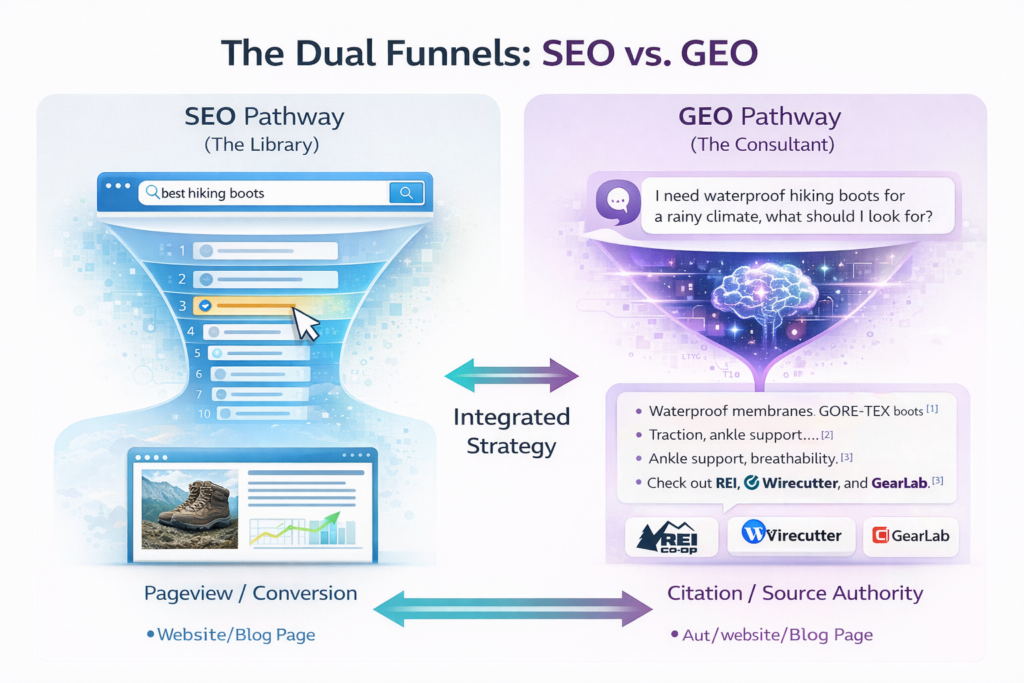
- SEO (The Library Model): Optimizes for a search engine’s algorithm to rank highly within a list of blue links. The user’s intent is interpreted by a keyword, and the result is a curated list of sources. Success is measured in rankings, clicks, and pageviews.
- GEO (The Consultant Model): Optimizes for a generative AI’s language model to be selected as a primary source for a synthesized, conversational answer. The user’s intent is expressed in natural language, and the result is a direct, consolidated response. Success is measured in citations, source mentions, and the accuracy of the AI’s paraphrase.
This distinction changes everything about optimizing for visibility. You’re no longer just competing for a click; you’re competing to be the most authoritative data point in a generative model’s knowledge base.
The GEO Mindset: From Keywords to Contextual Concepts
While SEO often focuses on keyword density and backlink profiles, GEO requires a deeper, more semantic approach.
- Authority is Everything, But It’s Scrutinized: Generative Engines are trained to prioritize sources with exceptional E-E-A-T (Experience, Expertise, Authoritativeness, Trustworthiness). However, they evaluate this contextually. A highly technical whitepaper might be sourced for a detailed query, while a reputable news outlet might be cited for a current event. Your content must establish undeniable authority on its specific subject to be considered.
- Structure for Synthesis, Not Just Scans: Generative AI pulls from content that is clear, well-structured, and rich in factual data. Use definitive headers (H2, H3) that directly state conclusions or answers. Employ bulleted lists, tables, and clear data points. The AI needs to easily identify and extract specific pieces of information to weave into its answer. This is the heart of optimizing for these new engines.
- Answer the Unasked Follow-Up: In a conversation, a user can ask for clarification. In GEO, your content must anticipate and preemptively answer these follow-ups. A section on “best practices” should naturally include “common pitfalls.” A product spec sheet should address “frequently compared alternatives.” This depth makes your content a more comprehensive and useful source for the AI’s synthesis.
Strategic Implications: The GEO vs. SEO Playbook
Your strategy must now operate on two parallel tracks:
- For SEO: Continue targeting high-intent commercial keywords (“buy hiking boots Denver”), optimizing for local search, and building a technically sound website for crawlers.
- For GEO: Focus on informational, “zero-click” query patterns (“how to break in new hiking boots,” “compare waterproofing methods for leather”). Create definitive, expert-led content that serves as the ultimate reference on a topic. Think in terms of being the textbook, not the brochure.
The most forward-thinking strategies will integrate both, using GEO to build top-of-funnel authority and trust, which then fuels brand recognition and credibility for bottom-of-funnel SEO conversions.
Conclusion: Optimizing for the Conversation
The rise of Generative Engines doesn’t spell the end of SEO; it signals its evolution. The dichotomy of GEO vs. SEO represents the expansion of the optimization field from a single channel (search) to a multi-interface reality (search + chat). By understanding that optimizing for a generative AI means structuring your expertise as clear, citable, and conversationally complete data, you future-proof your content. In the coming landscape, visibility won’t just be about being found—it will be about being quoted, referenced, and trusted as the source of truth in an ongoing, AI-facilitated dialogue.